Is adolescence the best and only time to undergo orthodontic treatment?
For decades, orthodontics has been associated mainly with adolescence. That stage of life when, in addition to physical and emotional changes, teeth are often the center of attention.
But is adolescence really the best and only time to correct dental problems?
The answer is more complex than it seems and reflects the evolution of orthodontics over time.
Adolescence: an ideal but not exclusive time
Adolescence, generally between the ages of 12 and 18, is considered the ideal time for orthodontic treatment, both for biological and practical reasons.
During this phase, the jawbones are still developing, which facilitates the correction of skeletal and dental problems. Malocclusions such as crowding, overbites (Class II), or open bites are easier to treat while the bone structures are actively growing.
In addition, adolescence usually marks the completion of permanent tooth eruption, which allows orthodontists to treat problems comprehensively. On the other hand, treatment at this stage is also often more socially acceptable, as it is common to see young people wearing braces or clear aligners.
However, this does not mean that adolescence is the only time for orthodontic treatment.

Orthodontics for adults: an increasingly common reality
In recent decades, the number of adults seeking orthodontic treatment has increased considerably. According to the Spanish Society of Orthodontics (SEDO), around 25% of current patients are adults. This is partly due to technological advances in this field, such as aesthetic brackets or transparent aligners, which offer discreet and effective solutions.
Although bone growth has stopped in adults, it is still possible to move teeth using mechanical forces. Treatment results are equally effective, although there may be more limitations (implants, missing teeth, periodontal disease, etc.).

In addition, many adults decide to start orthodontic treatment to correct problems that were not treated in their youth or to resolve associated complications, such as tooth wear, chewing difficulties, or temporomandibular joint (TMJ) problems.

What about children? The role of interceptive orthodontics
Although less common, in some cases orthodontic treatment can begin in childhood. Interceptive orthodontics, applied between the ages of 6 and 10, is intended to prevent major problems. For example, in children with crossbites, severe crowding, or habits such as thumb sucking, braces can be used to guide growth and prevent future complications.
Why is adolescence a good time for orthodontics?
-
Change from deciduous teeth to permanent teethBy adolescence, many children have lost most of their baby teeth and have almost all of their permanent teeth. This allows us to work on a more stable set of teeth and facilitates orthodontic treatment.
-
Facial and bone growthDuring this phase, the jawbones are still developing, which makes tooth movement more efficient and allows for orthopedic corrections when necessary.
-
Preventing future problemsTreating orthodontic problems in adolescence prevents complications in adulthood, such as misalignment, bite problems, TMJ issues, and uneven tooth wear.
-
Faster resultsThanks to the period of active growth, treatments performed during adolescence are generally faster and have fewer limitations than in adults.

What are the most common malocclusions corrected in adolescents?
The most common malocclusions corrected in adolescents with orthodontics are:
- Class I with crowding:
The relationship between the dental arches is normal, but the teeth are misaligned due to lack of space. This can cause aesthetic problems and difficulties with oral hygiene. - Class II, division 1 (overbite):
The upper teeth are too far forward in relation to the lower teeth, creating a convex profile and increasing the risk of trauma to the front teeth. - Class II, division 2:
There is a misalignment between the arches, but the upper incisors are tilted inward, creating a more closed profile and functional problems. - Class III (underbite):
The lower teeth are in front of the upper teeth, which can cause a concave profile and chewing difficulties. - Open bite:
There is a gap between the upper and lower teeth when the mouth is closed. This may be linked to habits such as thumb sucking, atypical swallowing, or mouth breathing. - Crossbite:
The upper teeth bite inside the lower teeth. It can occur on one side or both, affecting facial symmetry.

Case report 1: The patient presented with Class III dentition, generalized dental malpositioning, and midline deviation with asymmetry. Her treatment was performed with clear aligners and micro-screws in the third and fourth quadrants to distalize (move backward) the lower arch.
- Diastemas:
These are excessive spaces between the teeth, usually in the upper incisors, which may be due to discrepancies in tooth size or the presence of an overdeveloped labial frenulum. - Ectopic eruptions:
These are teeth that deviate from their normal eruption path. One of the most common is the canine, which sometimes moves toward the palate.

Case report 2: The patient presented with Class II dental division 2, with extensive overbite and ectopic eruption of the upper canines. Orthodontic treatment was performed with multiple transparent brackets and fenestration surgery on both canines. Due to the palatal position of the canines, we placed two micro-screws to help us pull them and separate the crown from the roots of the incisors. Subsequently, we pulled them from the vestibular side with the help of a spring to place them in their position in the arch.
These problems are usually easier to correct during adolescence due to bone growth, which allows for more effective modification of dental and skeletal structures.
Most common types of orthodontic treatment in adolescence
- Brackets:
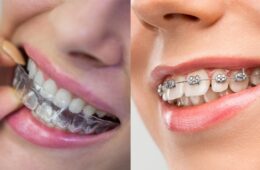
These are the most common type and consist of small accessories fixed to the teeth, which are connected by a wire. Brackets can be metal or aesthetic (ceramic or sapphire, less visible). - Clear aligners:
Clear plastic aligners are used and changed from time to time. They are discreet and can be more comfortable, but they are not suitable for all cases, especially for complicated diagnoses. - Auxiliary devices:
In some cases, additional devices such as jaw expanders may be used.
Considerations regarding adolescents
- Responsibility:
Teenagers should be responsible for dental hygiene, as orthodontic appliances can accumulate food debris and plaque that can lead to cavities and gum disease. - Duration of treatment:
Orthodontic treatment in adolescence usually lasts 12 to 18 months, depending on the complexity of the case. During this period, it is important to keep follow-up appointments to adjust the braces and ensure that treatment is progressing as expected. - Adjustment and discomfort:
At the beginning of treatment, you may experience some discomfort or irritation due to the movement of your teeth. As treatment progresses, adjusting to the braces usually becomes easier.
Conclusion: orthodontics has no age limit
Although adolescence is an ideal time to treat orthodontic problems due to active growth, it is neither the only nor the last time to do so.
Orthodontics is available to people of all ages, and the best time to start treatment is when the need is identified, the diagnosis is appropriate, and the patient’s priorities are taken into account.
In today’s world, where oral health and aesthetics are increasingly valued, orthodontics is a powerful tool for improving not only your smile, but also your quality of life.
Therefore, regardless of the stage you are at, it is never too late to start. If you have any questions, the best thing to do is to consult an orthodontist, who can guide you and draw up a personalized plan that suits your needs and goals.
Orthodontics FAQs
Is adolescence the only time to undergo orthodontic treatment?
No. Although adolescence (12-18 years) is considered ideal due to active bone growth, orthodontics can be performed at any age. About 25% of current orthodontic patients are adults, and there are also interceptive treatments for children between the ages of 6 and 10.
Why is adolescence considered the best time for orthodontic treatment?
During adolescence, the jawbones are still developing, making it easier to correct skeletal and dental problems. In addition, most permanent teeth have already erupted, allowing for comprehensive treatment with faster results.
What types of orthodontic appliances are available for teenagers?
The main types are: metal brackets (the most common), aesthetic brackets (ceramic or sapphire, less visible), transparent aligners (discreet and removable), and auxiliary devices such as jaw expanders for specific cases.
How long does orthodontic treatment last in adolescence?
Orthodontic treatment in adolescence usually lasts between 12 and 18 months, depending on the complexity of the case. During this period, regular appointments are necessary for adjustments and progress monitoring.
What are the most common dental problems corrected with orthodontics in adolescents?
The most common malocclusions include: dental crowding, overbite (Class II), open bite, crossbite, diastemas (spaces between teeth), and ectopic eruption of canines.
Can adults undergo orthodontic treatment with the same results as teenagers?
Yes, the results are equally effective in adults. Although bone growth has stopped, teeth can be moved using mechanical forces. There may be some additional limitations, such as existing implants or periodontal disease.